Key takeaways
- AI in freight today is mostly fast pattern matching on load, rate, and sensor data — genuinely useful, not autonomous judgment.
- It performs best on commoditized dry van lanes and worst on multi-stop, permitted, and relationship-dependent freight.
- Fraud screening is where AI is delivering the clearest value to honest carriers, because clean authority and tracking history now speed up your bookings.
- Driverless trucking is real but narrow: Aurora states it began commercial driverless operations in Texas on May 1, 2025, on a fixed highway lane.
- The practical move for most owner-operators is using the AI already inside your load board and TMS, not buying another subscription.
Will AI Replace Truck Dispatchers?
No — but it is changing what a good dispatcher does. Five years ago a large share of a dispatcher's day went on work that software now does better: scanning load boards, calculating mileage and fuel cost, checking rate averages for a lane, and matching basic equipment requirements to available trucks. If that is all your dispatcher does, AI is already eating that job.
The dispatchers thriving in 2026 stopped competing with algorithms on data processing speed. They compete on the four things below — and if you are weighing software against a person, our dispatch service vs self-dispatch comparison walks through the same trade-off from the carrier's side.
Negotiation with Context
Say a broker posts a load at $2.10/mile. Software sees the market average and either accepts or rejects against a threshold. A dispatcher who works that broker regularly may know their original carrier fell through and the load delivers tomorrow — so there may be room to move on the posted rate. That context, knowing the human on the other end of the phone, is the part no algorithm has.
Relationship Management
Preferred carrier status with a broker means you get first call on their best loads — before they hit the load board, before the scanners see them. You can't algorithm your way into a relationship. It takes consistent service, communication during problems, and a human being who answers the phone.
Exception Handling
Your driver breaks down at 2 AM in rural New Mexico with a perishable load. Software can flag the problem. A dispatcher can solve it — calling a backup carrier, negotiating with the receiver on the delivery window, arranging roadside service, and keeping the broker informed. These situations require human judgment and live communication.
Strategic Positioning
Knowing that produce season is about to ramp in South Georgia and positioning your truck there three days early isn't just data — it's market intuition built from experience. Software can show you historical patterns. A good dispatcher acts on them with timing moves that account for your specific truck, driver preferences, home time, and maintenance schedule.
The analogy we use at Truck Dispatch Experts: AI in dispatch is like GPS in a truck. GPS gives you the optimal route. It does not know about the construction zone that started yesterday, the scale running Level 1 inspections, or the shortcut through the industrial park. A good driver uses GPS as a tool and overrides it when experience says otherwise. A good dispatcher uses AI the same way. If you want the negotiation half of that skill for yourself, start with our freight rate negotiation guide.
What "AI in Trucking" Actually Means in 2026
There is a wide gap between "AI is in the software I use" and "AI is running my trucking business." Three technology waves are converging, and it helps to name them so you can tell which one a vendor is actually selling you.
Agentic AI means systems that take actions rather than only answering questions — in freight, platforms that will quote, book, or re-route on routine lanes without a person clicking approve. Factory-embedded OEM telematics means manufacturers such as Daimler, PACCAR, and Volvo building diagnostics and fleet management into the truck at the assembly line. Edge AI means processing sensor data on the truck instead of shipping it to the cloud, so driver-assist and safety decisions happen in real time.
Here is the honest assessment: most of what is deployed and working in 2026 is smart automation rather than judgment. Load matching that scans every board continuously has existed for years — it is just faster and better-filtered now. Predictive maintenance that flags a DPF issue before it strands you is pattern recognition on sensor data, not a machine that understands your business. The tools are genuinely better than they were two years ago. They are not magic.
What matters for owner-operators and small fleets is not whether AI is "real" in a philosophical sense — it is whether these tools save money, find better loads, and keep the truck rolling. This article sits inside our truck dispatch and load finding guide hub; for the wider market backdrop, see our 2026 trucking industry forecast.

How AI Load Matching Works — And Where It Fails
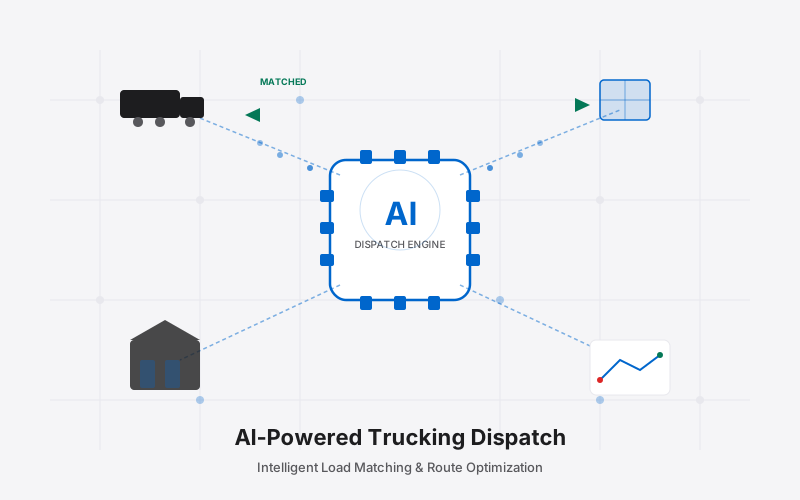
The most visible application of AI in trucking right now is load matching and pricing. Digital freight platforms — Uber Freight, Flexport, and Loadsmart — use machine learning to predict market rates, match carriers to loads, and auto-book freight on some lanes.
Here is how it works in practice: when a shipper posts a load, the platform weighs historical lane rates, current supply and demand, fuel cost, day of week, seasonality, weather, and available carrier capacity within range. It produces a price recommendation — sometimes it sets the price outright — and surfaces the load to carriers whose profile, equipment, and location fit.
Where it works well: simple, high-volume freight. A 40,000 lb dry van load from Dallas to Atlanta on a Tuesday has thousands of historical data points behind it and prices accurately in seconds. For carriers the benefit is speed — loads matched to your location and equipment appear instead of you scrolling boards. Both major boards have added these features; our DAT vs Truckstop comparison covers what each one includes.
Where it struggles: complex freight exposes the limits fast. Multi-stop loads with varying appointment windows, oversized permits that differ by state, temperature-sensitive pharmaceutical freight, or anything needing negotiation and relationship context — algorithms consistently underperform experienced dispatchers here. The software does not know that a particular broker always lowballs the first offer, or that a shipper's "two-hour appointment window" means a six-hour wait. That is institutional knowledge living in a dispatcher's head.
Freight pricing algorithms also carry a structural bias toward rate compression on high-volume lanes. When pricing is set from historical averages and current supply, it converges toward the mean — good for consistency, less good for a carrier who could do better through relationships or timing. That is the case for pairing the tools with a human. Benchmark your own numbers first with our free trucking calculators.
AI Dispatch Software vs a Human Dispatcher
Beyond the big freight platforms, a category of AI dispatch tools has emerged marketed directly at carriers and dispatch services — for example Dispatch Science. These platforms promise to automate load selection, route optimization, and driver communication: a dispatcher in a box.
What do they actually do? Usually some combination of scanning multiple load boards at once, filtering by your equipment and location, predicting rate trends for the days ahead, optimizing multi-stop routes, and generating driver updates. Some read ELD data to respect hours-of-service availability. The better ones learn your lane preferences over time.
The honest reality: these tools are useful as assistants. They remove hours of manual board searching and catch opportunities a person scanning by hand would miss. They matter most once one dispatcher is juggling more trucks than they can watch closely.
| Capability | AI Dispatch | Human Dispatcher |
|---|---|---|
| Load board scanning speed | Watches multiple boards continuously, no fatigue | Manual scanning, limited to 1-2 boards at a time |
| Rate prediction accuracy | Strong on high-volume lanes, weak on niche freight | Market intuition + relationship knowledge of broker pricing |
| Route optimization | Mathematically optimal with traffic and fuel data | Experience-based, knows dock conditions and real wait times |
| Broker negotiation | Can't negotiate — accepts or rejects posted rates | Negotiates above posted rates using broker history and lane context |
| Problem resolution | Can flag issues, can't resolve them | Calls broker, reroutes driver, arranges lumper, handles exceptions |
| Relationship building | No capability — purely transactional | Builds preferred carrier status, gets first-call on premium loads |
| 24/7 availability | Always on, instant responses | Business hours typically, on-call for emergencies |
| Consistency | Same quality every time, no bad days | Varies — great dispatchers are great, but quality ranges widely |
This table is our own editorial assessment as a dispatch service, based on the platform capabilities we see in day-to-day use. It is not a vendor benchmark, a controlled test, or a third-party study, and no cell should be read as a claim about what any carrier will earn.
The takeaway is not that AI is bad or humans are obsolete — it is that the strengths are complementary. The strongest dispatch operations use software for the data-heavy repetitive work and people for negotiation, relationships, and exceptions. If you are evaluating providers on exactly that basis, our guide to choosing a truck dispatch company lists the questions worth asking, including which tools they run internally.
How Much Does AI Dispatch Software Cost?
We are not going to publish a price list we cannot stand behind. Almost none of the vendors in this category publish flat list pricing, quotes are negotiated per fleet, and any number we printed here would be stale within a quarter. What we can describe is the shape of the cost, which is what actually drives the decision.
- Already-paid-for AI. Rate prediction and load recommendation features on the major load boards are typically bundled into the subscription you already hold. Marginal cost: zero. Start here.
- TMS add-ons. Route optimization and rate analysis modules inside a TMS are usually priced per user or per truck per month, on top of the base platform.
- Dedicated AI dispatch platforms. Quote-based, generally per truck per month with an onboarding fee, and often a minimum seat or truck count that makes them awkward for a single-truck authority.
- A dispatch service. A percentage of gross or a flat weekly fee, with the tooling absorbed by the provider. Our own dispatch pricing is published, and our guide to truck dispatch rates explains how the fee models compare across the industry.
Rather than trusting anyone's breakeven rule of thumb — including ours — put your own miles, rate, and fee into the dispatch ROI calculator. A subscription only makes sense when the loads it surfaces, net of the fee, beat what you are booking today.
How AI Detects Double Brokering and Broker Fraud
Fraud detection is where AI is delivering the clearest value to honest carriers. Double brokering — a broker accepting a load and then illegally re-brokering it to another carrier without the shipper's knowledge — leaves carriers unpaid and shippers blind to where their freight is, and the schemes have grown more sophisticated. Trade-press estimates of the annual cost to the industry run into the hundreds of millions of dollars, but the published figures vary widely by methodology, so treat any single number you see with caution. Our double brokering protection guide covers what to do if a load you hauled turns out to have been re-brokered.
The detection systems work by analyzing patterns across many data points at once, flagging anomalies no human could catch at scale: a carrier authority activated only days before it tries to book a high-value load, GPS signals that do not match the truck's reported position, payment routing to accounts linked to earlier fraud, or communication patterns that suggest a middleman rather than the carrier on the rate confirmation.
Carrier-vetting vendors including Highway, Carrier411, and RMIS build this screening into their platforms, and several large brokers have built their own. The FMCSA has also stepped up enforcement against fraudulent registrations and chameleon carriers; we track what that means for compliant carriers in the 2026 broker fraud crackdown.
What this means for legitimate carriers: the screening works in your favour. Clean authority history, consistent tracking data, and an established payment record make you low-risk in these systems, which means faster approval and fewer holds. If your authority is new, expect extra verification while it is new — annoying, but it is the same filter protecting you from the fraud.
Is Predictive Maintenance AI Worth It?
An unplanned breakdown costs far more than the repair bill. Add the tow, the load you could not deliver, detention or missed-appointment penalties, and the days lost waiting on parts and shop time, and a single roadside failure can easily run into five figures. Predictive maintenance aims to convert that into a scheduled shop visit. Pair it with a disciplined PM programme — our truck maintenance schedule guide sets out the intervals — because the software only tells you what the sensors see.
OEM Telematics (Built-In)
Detroit Connect, Cummins Connected Diagnostics, PACCAR Connected Truck, and Volvo Remote Diagnostics ship with modern trucks and monitor engine parameters, aftertreatment systems, and drivetrain components in real time. When readings drift from normal, the system alerts you and your dealer before a failure.
Included with the truck — but check whether your tier converts to a paid subscription after an introductory period
Aftermarket Platforms
Vendors such as Uptake, Geotab, and Platform Science add telematics hardware and analytics to older trucks. They read the diagnostic port and monitor fault codes, fuel consumption, idle time, hard braking, and wear indicators.
Subscription, priced per truck per month — get a current quote
Tire Pressure Monitoring
TPMS tracks pressure, temperature, and wear across every position and flags a tire trending toward failure so you can replace it on your schedule rather than on the shoulder. Tire issues are consistently among the leading causes of roadside breakdowns, which is why this is usually the first sensor carriers add.
Hardware plus per-wheel sensors — quoted per truck
DPF/Aftertreatment Monitoring
The most expensive and frustrating maintenance area on a modern diesel. These systems track soot loading, regen frequency, DEF consumption, and sensor drift to surface a developing DPF problem while you can still book a shop appointment instead of taking a roadside regen or a derate.
Usually included in OEM telematics
How to think about the return: the arithmetic is simple even without industry averages. Take your own subscription cost for a year, and compare it to what one breakdown actually cost you the last time it happened — pull the invoice, the tow receipt, and the revenue you missed. If the software would plausibly have caught that failure, it pays. If you have never had one, the honest answer is that the case is weaker on a single truck and gets stronger with every truck you add, because the odds of at least one failure a year rise with the fleet.
The biggest obstacle is not the technology. It is drivers and owners ignoring alerts because the truck "still runs fine" — the same instinct behind most unresolved ELD faults, which brokers' scoring systems also read.
When Will Autonomous Trucks Replace Truck Drivers?
No discussion of AI in trucking is complete without the elephant in the cab, and no topic in trucking generates more misinformation. So here is what the companies themselves publish, checked in August 2026.
Aurora Innovation is the furthest along commercially. Aurora's own site states it began commercial driverless trucking in Texas on May 1, 2025, and describes the driverless work in terms of hauling freight between Fort Worth and El Paso — a quote from Werner Enterprises' CEO on that page refers to exactly that lane. Werner, Hirschbach, Schneider, and Uber Freight appear among its named partners. Aurora's investor newsroom shows the programme moved on again in July 2026, with a release titled "Aurora Launches Second-Generation Driverless Trucks in U.S." followed by further carrier deployment announcements later that month.
Kodiak Robotics and Torc (owned by Daimler Truck) are also developing autonomous trucks, largely across the same Sun Belt geography. Waymo is not. Its former trucking programme, Waymo Via, is no longer a business line — waymo.com today lists ride-hailing and its Waymo Driver platform and no trucking operation at all. If you see Waymo named in a 2026 autonomous trucking roundup, that roundup is out of date. We track who is actually running where in our autonomous truck corridors guide.
Now the scale. We are not going to publish a fleet-count projection we cannot source — nobody in this field publishes a reliable industry-wide truck count, and the numbers that circulate are usually someone's guess repeated until it sounds official. What we can anchor is the denominator. The American Trucking Associations publishes 14.89 million single-unit and combination trucks registered in the US in 2023, and 3.58 million truck drivers employed in 2024. Against a fleet counted in the millions, the driverless trucks running today are a rounding error, whatever the exact figure turns out to be.
What driverless trucks can do in 2026: long-haul, fixed-route, divided-highway running in favourable weather. That is it. They do not navigate city streets, back into loading docks, chain up for mountain passes, work shifting construction zones, or operate in severe weather. Each run needs a transfer hub at both ends where a human takes the first and last miles.
What this means for owner-operators: on current deployment rates, we do not expect autonomous trucks to displace meaningful owner-operator work this decade. We are stating that as our assessment, not as a forecast we can source — anyone quoting you a precise year and percentage is guessing. Local pickup and delivery, drayage, construction, agricultural freight, and anything involving dock work will stay human-driven longest.
The segment that will feel competitive pressure first is exactly the one autonomy targets: long-haul, high-volume, divided-highway freight. If that is all you run, the sensible hedge is to build capability in work that is harder to automate — specialized equipment, regional routes with complex pickup and delivery, and relationship-driven freight.
What Owner-Operators Should Do About AI in 2026
Enough theory. Four practical steps that make AI work for you rather than against you:
Switch On the AI You Already Pay For
If you use DAT, Truckstop, or any major board, turn on their rate predictions, location-and-equipment load recommendations, and market trend alerts — they are usually inside your existing subscription. If you run a TMS such as TruckingOffice or Axon, look at the route optimization and rate analysis modules you have never opened. Motive (formerly KeepTruckin) and Samsara are ELD and fleet-ops platforms rather than a TMS, but their data feeds the same decisions. You don't need to buy a separate AI platform. You need to use what you are already paying for.
Keep Your ELD Data Clean — It Is Your Algorithmic Reputation
Brokers and platforms increasingly read your operating data when they decide who gets tendered a load. On-time percentage, hours-of-service compliance, and consistent availability all feed automated carrier scoring. Carriers with clean profiles get surfaced first; carriers with unresolved faults and gaps get filtered out before a human ever sees them. Treat your ELD as your digital reputation, not just a compliance box.
Focus on Freight Algorithms Can't Commoditize
AI is best at standardized freight on high-volume lanes. The more complex and specialized your work, the less software competes with you. Multi-stop routes, hazmat, oversized and overweight, team expedite, high-value cargo, and anything needing specific equipment configuration all resist algorithmic optimization. Specialized freight generally pays a premium over standard dry van simply because fewer carriers can legally and physically run it — check live equipment-type rate data for your lanes rather than assuming a fixed percentage.
Partner with a Tech-Forward Dispatch Service
For most owner-operators the smartest move is not buying software — it is working with a dispatch service that runs these tools on the back end and puts a person on the phone at the front. You get automated load matching, rate analysis, and market intelligence combined with human negotiation, relationships, and exception handling, without managing another subscription yourself.
New to how the dispatch relationship works at all? Start with how truck dispatch works, then come back to the tooling question — the technology only matters once the workflow makes sense.
Related Resources
- Truck Dispatch & Load Finding — the full guide hub this article belongs to
- 2026 Trucking Industry Forecast — rate projections, freight volumes, and market outlook
- Autonomous Truck Corridors 2026 — which companies run driverless freight, and where
- Load Boards vs. Dispatch vs. Brokers — how different freight-finding methods compare
- Dispatch Service vs Self-Dispatch — the software-or-a-person decision, costed out
- Dispatch ROI Calculator — run your own breakeven instead of trusting a rule of thumb
- Broker Fraud Crackdown 2026 — how automated screening powers the new vetting requirements
- Driver Shortage 2026 — what the driver pool actually looks like
- ATA Economics & Industry Data — the registration and employment figures cited above
- Aurora Innovation press releases — primary source for the driverless timeline