Why This Guide Exists
The dispatch industry has a transparency problem. Some companies advertise "5% dispatch" but tack on $200 in monthly fees. Others charge 10% but deliver rates so good that your net revenue jumps 25%. The percentage alone tells you almost nothing.
We're a dispatch company (yes, we have skin in this game), but we also believe informed carriers make better decisions — and become better long-term clients. This guide gives you the real numbers, the real pricing models, and the questions to ask before committing your paycheck to anyone.
The Three Dispatch Pricing Models
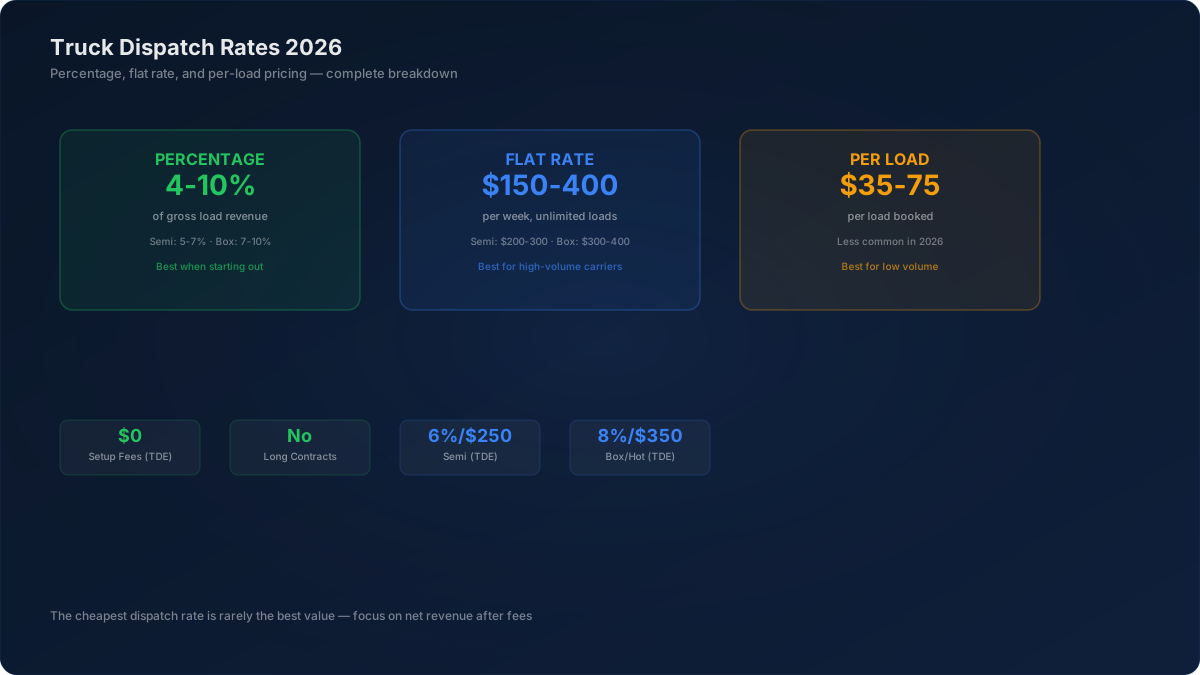
Nearly every dispatch company uses one of three pricing structures. Understanding each helps you compare companies and calculate your true cost.
1. Percentage-Based Pricing
The most common model. You pay a percentage of the gross load revenue on every load your dispatcher books.
Industry Range
4% – 10%
Most Common
5% – 8%
Pros: Low barrier to entry. You only pay when you earn. Cost scales with revenue. Dispatcher is incentivized to find higher-paying loads.
Cons: Costs more during high-revenue weeks. Can feel expensive on premium loads. Some dispatchers prioritize volume over quality to maximize their cut.
2. Flat Weekly Rate
You pay a fixed dollar amount per week regardless of how much freight your dispatcher books. Becoming more popular in 2026.
Semi Trucks
$150 – $400/wk
Box Truck/Hotshot
$200 – $500/wk
Pros: Predictable cost. Better value for high-revenue carriers. Pay the same on $5,000 loads as $1,500 loads.
Cons: You pay even during slow weeks. Some flat-rate services provide less individualized attention. Need consistent volume to justify the cost.
3. Per-Load Fee
A fixed dollar amount per load booked. Less common but used by some newer dispatch services.
Industry Range
$25 – $75/load
Best For
Part-time carriers
Pros: Great for part-time carriers who run fewer loads. Very transparent cost per transaction.
Cons: Dispatcher may be less motivated to maximize your rate (they get paid the same whether it's a $1,500 or $3,500 load). Not cost-effective for full-time carriers.
2026 Dispatch Rate Comparison by Equipment Type
Dispatch rates vary by equipment type because specialized trailers require more expertise and the freight typically pays more. Here's what the market looks like in 2026:
| Equipment Type | % Rate Range | Flat Rate Range | Avg Load Revenue |
|---|---|---|---|
| Dry Van | 5-7% | $150-300/wk | $2,000-4,500 |
| Reefer | 5-8% | $200-350/wk | $2,500-5,500 |
| Flatbed | 6-8% | $200-350/wk | $2,500-5,500 |
| Step Deck | 6-8% | $200-350/wk | $2,500-5,000 |
| Power Only | 5-7% | $150-300/wk | $1,800-4,000 |
| Hotshot | 7-10% | $250-400/wk | $800-3,000 |
| Box Truck | 7-10% | $250-400/wk | $600-2,500 |
| Heavy Haul/RGN | 6-10% | $300-500/wk | $3,000-10,000+ |
Ranges reflect market averages across multiple dispatch providers. Individual rates vary by company, region, and service level.
Where Truck Dispatch Experts Fits
Full transparency — here's exactly what we charge:
Semi Truck Dispatch
Covers: Dry Van, Reefer, Flatbed, Step Deck, Power Only, Heavy Haul
Box Truck & Hotshot
Covers: Box Trucks, Sprinter Vans, Hotshot Trailers
Switch anytime: You can move between percentage and flat rate whenever it makes sense for your business. Most of our high-volume carriers choose flat rate. Carriers ramping up or running part-time prefer percentage. No penalty for switching.
Percentage vs Flat Rate: When to Switch
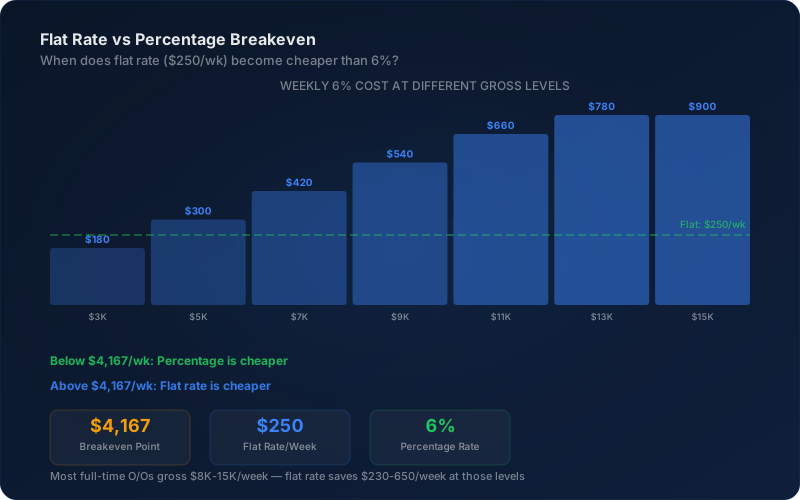
The breakeven point is simple math. If your weekly gross revenue exceeds the flat rate divided by the percentage rate, flat rate saves you money.
| Weekly Gross | 6% Cost | $250 Flat | Better Option |
|---|---|---|---|
| $3,000 | $180 | $250 | Percentage |
| $4,167 | $250 | $250 | Breakeven |
| $6,000 | $360 | $250 | Flat Rate |
| $8,000 | $480 | $250 | Flat Rate |
| $10,000 | $600 | $250 | Flat Rate |
| $15,000 | $900 | $250 | Flat Rate |
Semi truck rates shown. For box truck/hotshot: 8% vs $350/week — breakeven at $4,375/week gross.
Hidden Fees to Watch For
The advertised dispatch rate is only part of the picture. Many carriers sign up at "5%" and end up paying the equivalent of 8-10% when hidden fees are included. Here are the most common:
Setup/Onboarding Fee
$50 – $500One-time. Should be $0 at any reputable company.
Weekly Technology Fee
$25 – $75/wkCharged for TMS access or tracking software. Often not disclosed upfront.
Broker Setup Fee
$10 – $50/brokerPer new broker they contact. Can add up fast on diverse load boards.
Paperwork/Admin Fee
$5 – $15/loadPer-load charge for rate confirmations and BOL processing.
After-Hours Fee
$50 – $100/callCharged for dispatch support outside business hours.
Cancellation Penalty
$200 – $1,000+Early termination fee for contracts. A major red flag.
Factoring Coordination Fee
0.5 – 2% extraAdditional percentage for coordinating with your factoring company.
How to Compare Dispatch Companies on Price
Don't compare the headline dispatch percentage. Compare the total monthly cost and, more importantly, the net revenue after all fees. Here's a framework:
Calculate Total Monthly Cost
Add up: dispatch fee (% × expected gross, or flat rate × 4 weeks) + all additional monthly fees. Ask each company for a complete written fee breakdown.
Ask About Trucks-per-Dispatcher Ratio
A dispatcher handling 5-8 trucks gives you real attention. One handling 20+ trucks is going to miss opportunities. The cheapest rate means nothing if your dispatcher can't focus on maximizing your loads.
Compare Net Revenue, Not Cost
A 6% dispatcher who negotiates $3.50/mi nets you more than a 4% dispatcher averaging $2.80/mi. Run the math on a typical month: (expected gross - total dispatch fees) = your take-home. The company that maximizes this number wins.
Ask for a Trial Period
Any company confident in their results should offer a no-contract trial. Run 2-4 weeks, compare your numbers to self-dispatching or your previous service. If they won't let you try without a contract, walk away.
Check What's Included
Does the rate include: load searching, rate negotiation, paperwork handling, broker setup, 24/7 support, billing assistance, and factoring coordination? Or are some of these extras? Full-service should mean full-service.
What Good Dispatch Is Actually Worth
The real question isn't "how much does dispatch cost?" — it's "does dispatch generate more revenue than it costs?" Here's where professional dispatch typically adds value:
+$0.20-0.50/mi
Higher Rates
Professional negotiation and market expertise consistently get above-average lane rates.
-5-10% empty miles
Less Deadhead
Route optimization and backhaul planning reduce unpaid miles between loads.
+15-25 hrs/month
More Driving Time
Hours spent searching and negotiating become billable driving hours instead.
2-3× options
Better Load Selection
Access to broker networks and shipper relationships you don't have on your own.
The math: A carrier grossing $12,000/month self-dispatching who switches to a 6% dispatch service generating $15,000/month pays $900 in fees but nets $2,100 more. That's a 233% return on the dispatch fee.
Pricing Red Flags
Related Resources
- Our Pricing Page — Transparent breakdown of TDE dispatch fees
- Dispatch vs Self-Dispatch — When professional dispatch is worth the cost
- How to Choose a Dispatch Company — 10-point evaluation beyond just price
- Cost Per Mile Calculator — Know your breakeven before evaluating dispatch fees
- Freight Factoring Guide — Factoring costs that stack on top of dispatch fees
Truck Dispatch Experts
Published Jan 20, 2026 · Updated Mar 1, 2026