The Bottom Line Upfront
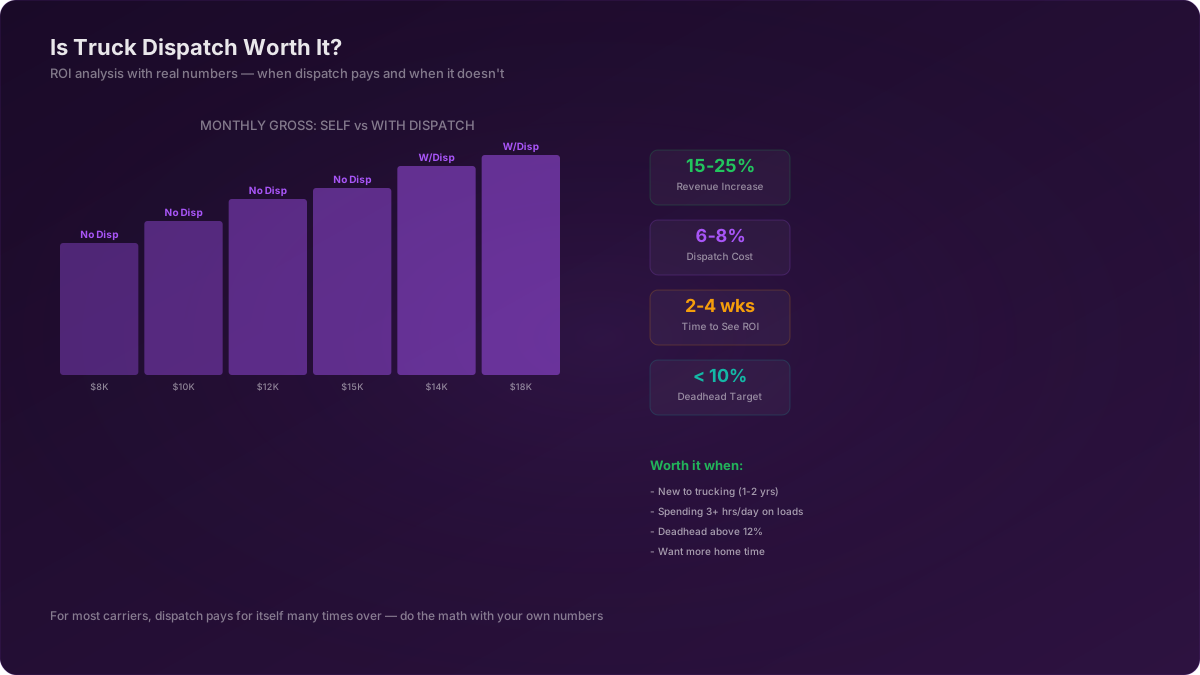
For most owner-operators and small fleets, professional dispatch is worth it — often generating 2-4× more revenue than it costs. But "most" isn't "all."
This guide gives you the real numbers to figure out where you fall. We're not going to sugarcoat it: if you already have strong broker relationships and you love negotiating rates, you might not need us. But if your truck is sitting empty, you're accepting low rates because you need to move, or you're spending half your day on load boards instead of driving — dispatch almost certainly pays for itself.
What Dispatch Actually Costs
Before calculating ROI, you need to know the real cost — not just the headline percentage.
| Monthly Gross | At 6% | At $250/wk | As % of Gross |
|---|---|---|---|
| $8,000 | $480 | $1,000 | 6.0% / 12.5% |
| $12,000 | $720 | $1,000 | 6.0% / 8.3% |
| $16,000 | $960 | $1,000 | 6.0% / 6.3% |
| $20,000 | $1,200 | $1,000 | 6.0% / 5.0% |
| $25,000 | $1,500 | $1,000 | 6.0% / 4.0% |
| $30,000 | $1,800 | $1,000 | 6.0% / 3.3% |
Semi truck rates shown (6% / $250/wk). High-volume carriers save significantly with flat rate pricing.
The ROI Calculation
Dispatch ROI comes from four sources. Here's how each contributes for a typical owner-operator running 10,000 miles per month:
Higher Rate Per Mile
Professional dispatchers negotiate rates all day as their full-time job. They have current market data, established broker relationships, and the experience to push for better pricing. Most carriers report $0.20-0.50 higher per-mile rates with dispatch vs self-dispatching.
Monthly impact at +$0.30/mi × 10,000 miles
+$3,000/month
Reduced Deadhead Miles
Self-dispatched carriers average 12-18% deadhead. Professional dispatchers plan routes to reduce empty miles, often getting deadhead below 8-10%. Every deadhead mile costs you fuel with zero revenue.
Saving 600 deadhead miles/month × $0.65/mi fuel
+$390/month
Recovered Driving Time
Self-dispatching takes 2-4 hours per day — load board searches, broker phone calls, paperwork, rate negotiations. That's 15-25 hours per week of unpaid administrative work. With dispatch, you spend maybe 30 minutes reviewing and approving loads.
Recovered 60+ hrs/month → more loads, more miles
+$1,000-2,000/month
Better Load Quality
Dispatchers have access to loads you don't see on public load boards — direct shipper relationships, preferred broker rates, and short-notice premium freight. They also filter out bad loads (late payers, chronic detention, lowball brokers) that waste your time.
Fewer detention events, fewer payment issues
+$200-500/month
Total Monthly Gain
$4,590-5,890
Dispatch Cost (6%)
-$900-1,200
Net ROI
+$3,390-4,690
Return: 3.8× – 4.9× the dispatch fee. For every $1 you spend on dispatch, you get $3.80-$4.90 back in additional net revenue. This is a conservative estimate based on industry averages — strong dispatchers with specialized equipment expertise often deliver higher returns.
Who Benefits Most from Dispatch
Not all carriers get the same ROI. Here's who sees the biggest returns:
New Authority Carriers
Highest ROINo broker relationships, no market experience, no reputation. Dispatch bridges all three gaps from day one. New carriers often see the highest percentage improvement.
Long-Haul OTR Operators
Very High ROIComplex multi-state routing, constantly changing markets, and no time to search while driving. Dispatchers keep you loaded and moving across every corridor.
Specialized Equipment
Very High ROIReefer, flatbed, heavy haul — the loads pay more but are harder to find. Specialized dispatchers know where these loads are and what they should pay.
Small Fleets (2-10 trucks)
High ROIYou can't manage drivers AND find loads AND negotiate rates AND do paperwork. Dispatch lets fleet owners focus on operations while someone else maximizes revenue.
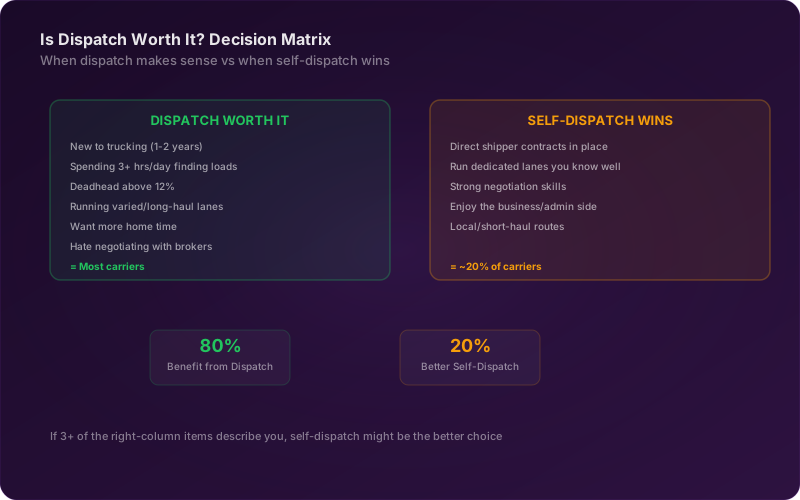
When Dispatch Is NOT Worth It
We'd rather be honest and lose a potential client than oversell and disappoint. Dispatch probably isn't worth it if:
- You have direct shipper contracts — If shippers call you directly with consistent, high-paying freight, a dispatcher adds little value. You already have what they provide.
- You run the same dedicated lane — Same pickup, same delivery, same schedule every week. There's nothing to negotiate or optimize. You don't need a dispatcher; you need a contract.
- You're a strong negotiator running high-paying lanes — If you're already consistently above market rate because of your relationships and skills, dispatch won't add much. Some carriers are just better at this than any dispatcher.
- You enjoy the business side — Some owner-operators genuinely like finding loads, talking to brokers, and managing their own freight. If that's you, the time "savings" isn't a real factor.
- Your margins are razor-thin — If you're running very low-margin freight where 6-8% wipes out your profit, you may need to fix the underlying business model before adding dispatch costs.
Self-Assessment: Is Dispatch Right for You?
Score yourself honestly on these 8 questions. Each "Yes" is a point toward dispatch being worth it for your operation:
Do you spend more than 1 hour per day searching for loads?
Is your deadhead percentage above 12%?
Do you often accept below-market rates because you need to move?
Do you have fewer than 10 reliable broker relationships?
Have you been operating under your own authority for less than 2 years?
Do you run OTR (out of your home region) regularly?
Would you rather drive than sit on the phone with brokers?
Are you growing to 2+ trucks and struggling to manage dispatch yourself?
0-2 "Yes"
Self-dispatch is likely fine for you. Revisit in 6 months.
3-5 "Yes"
Dispatch would likely improve your revenue. Try a no-contract service for a month.
6-8 "Yes"
You're almost certainly leaving money on the table without dispatch.
How to Test if Dispatch Works for You
Don't take anyone's word for it — including ours. Here's how to run a proper test:
Track Your Current Numbers for 2 Weeks
Before signing up with anyone, record your current: average rate per mile, deadhead percentage, hours spent finding loads, number of loads declined vs accepted, and total weekly gross revenue.
Choose a No-Contract Dispatch Service
Never commit to a long-term contract for a test. Choose a service (like ours) that lets you cancel anytime. If a company won't let you try without a contract, that tells you everything.
Run 4 Full Weeks with Dispatch
Give your dispatcher time to learn your preferences and build momentum. One bad week doesn't mean dispatch doesn't work — and one great week doesn't prove it does. Track the same metrics from step 1.
Compare the Numbers
After 4 weeks, compare: net revenue after dispatch fees vs. self-dispatch net revenue, deadhead reduction, hours recovered, and load quality (fewer issues, faster payment). If dispatch nets you more money after fees, it's worth it. Period.
The Opportunity Cost Nobody Talks About
The dispatch fee is visible. What most carriers overlook is the invisible cost of NOT having dispatch:
- 20 hours/week on load boards and broker calls — time you could be earning or resting
- $0.10-0.40/mi left on the table from accepting first-offer rates
- 500-1,000 extra deadhead miles/month from poor route planning
- Stress and fatigue from managing business operations while driving 500+ miles per day
- Missed loads because you were driving and couldn't respond to a hot board posting
When you add up the invisible costs, most carriers discover they're already "paying" far more than 6% — they're just paying it in lost revenue, extra miles, and personal burnout instead of a dispatch fee.
Related Resources
- Truck Dispatch Rates 2026 — Complete pricing guide for dispatch services
- Dispatch vs Self-Dispatch — Detailed side-by-side comparison
- Cost Per Mile Calculator — Know your real operating cost before evaluating dispatch
- Deadhead Calculator — See how much empty miles cost you
- Our Pricing — Transparent dispatch fees, no hidden charges
Truck Dispatch Experts
Published Feb 1, 2026 · Updated Mar 1, 2026