What Makes a State Good for Trucking?
Not all states are created equal when it comes to running a trucking business. Some states make it easy to turn a profit with low taxes, high freight volume, and well-maintained roads. Others seem designed to drain your wallet through tolls, regulations, and fuel costs before you ever see a paycheck. Understanding these differences is not just academic — where you domicile your truck, where you run your lanes, and where you pick up freight directly impact your bottom line every single week.
We evaluate states across four core factors that matter most to owner-operators and small fleet owners:
Freight Volume
The single most important factor. A state with no income tax but no freight is useless. You need consistent load availability in multiple directions so you are never sitting empty or chasing loads at desperation rates. We look at total tonnage, load-to-truck ratios, and the diversity of freight types (dry van, reefer, flatbed) to gauge whether a state can keep trucks moving profitably.
Tax Burden
State income tax is the big one, but it is not the only tax that matters. Fuel taxes, registration fees, vehicle property taxes, and special assessments like Oregon's weight-mile tax all add up. We consider the total tax picture — not just the income tax headline — to calculate how much of your gross revenue you actually get to keep at the end of the year.
Regulations
Some states have straightforward trucking regulations. Others pile on emissions requirements, restricted delivery hours, unique permitting processes, and enforcement patterns that cost you time and money. California's CARB rules are the most well-known example, but states like New York and Oregon have their own regulatory headaches that you need to account for.
Road Quality & Infrastructure
Good roads reduce maintenance costs, lower fuel consumption, and improve transit times. We factor in highway conditions, toll costs, truck parking availability, interstate connectivity, and the presence of major distribution hubs and intermodal facilities. A state at the crossroads of two or three major interstates is inherently more valuable than one at the end of a dead route.
With those four factors in mind, here are the definitive rankings for 2026. These rankings reflect real-world conditions — not just spreadsheet data, but the kind of on-the-ground knowledge that comes from dispatching trucks across all 48 contiguous states every day.
Top 10 Best States for Trucking
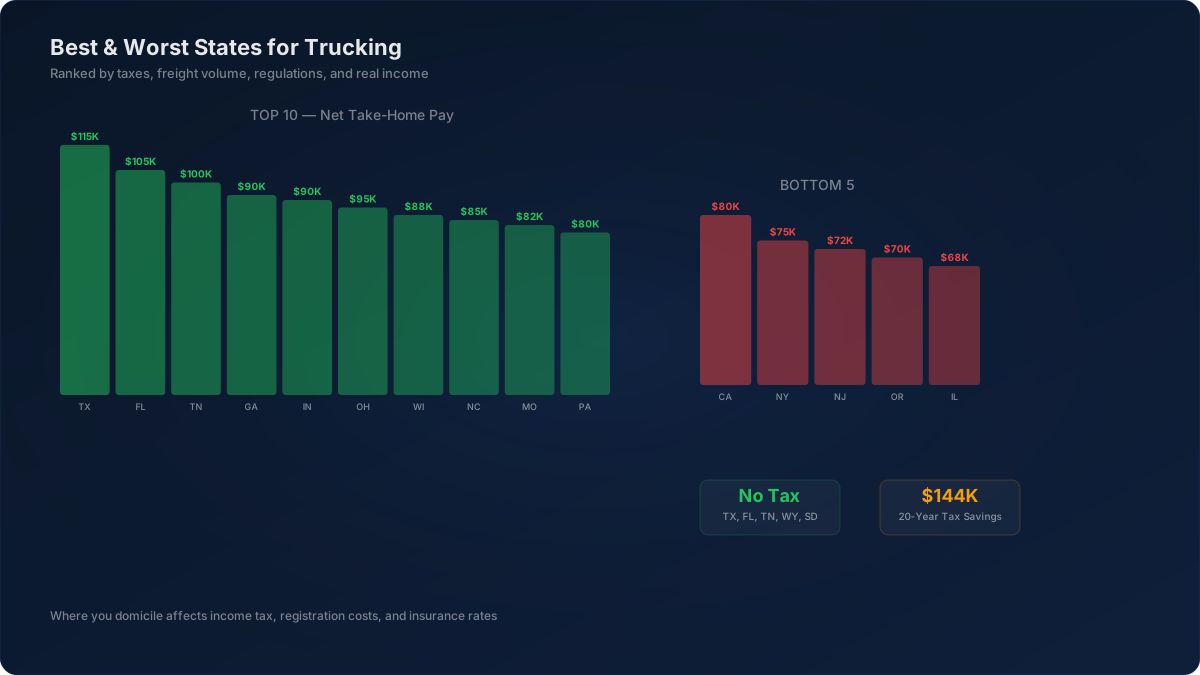
These ten states offer the best combination of freight availability, tax friendliness, infrastructure, and overall profitability for owner-operators and small fleets. Whether you are choosing a domicile state for your business or deciding which lanes to prioritize, these are the states that put money in your pocket.
Texas
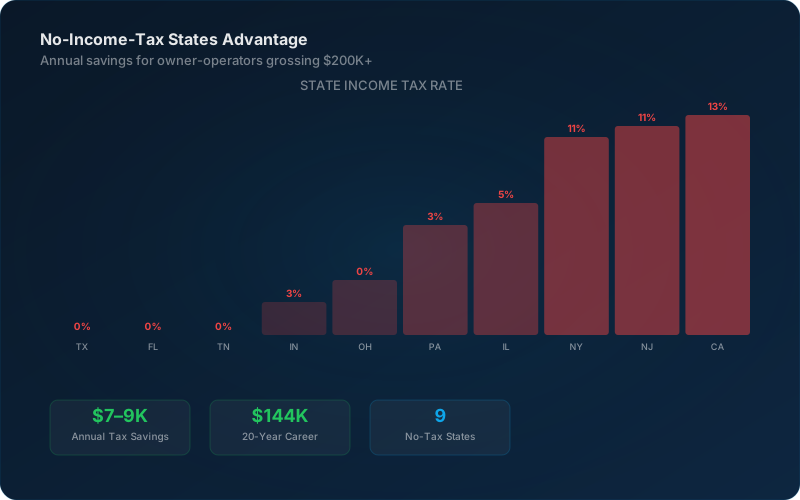
- •No state income tax saves owner-operators $7,000-$9,000 annually on typical earnings
- •Highest freight volume of any US state, driven by oil and gas, agriculture, manufacturing, and three major ports (Houston, Corpus Christi, Beaumont)
- •I-35 is the primary NAFTA corridor connecting Mexico to the Midwest, generating billions in cross-border freight annually
- •Diverse freight base means you are never dependent on a single industry cycle — when oil dips, agriculture and port freight pick up the slack
Florida
- •No state income tax combined with year-round produce season makes it a powerhouse for reefer carriers
- •Three major port complexes (Miami, Jacksonville, Tampa) generate steady inbound and outbound container freight
- •Fastest-growing population in the US drives consistent demand for consumer goods, building materials, and retail freight
- •Strong backhaul market heading north on I-95 and I-75 corridors reduces deadhead risk
Tennessee
- •No state income tax plus a central geographic location that puts you within a day's drive of 75% of the US population
- •Nashville and Memphis are massive distribution hubs — Memphis alone is home to FedEx's global hub and multiple major DC clusters
- •I-40 and I-24 crossroads create natural freight corridors running east-west and north-south
- •Lower cost of living than most comparable logistics states, keeping your operating overhead manageable
Georgia
- •Atlanta is the second-largest distribution hub in the country, with major fulfillment centers from Amazon, Walmart, Home Depot, and dozens of regional distributors
- •The Port of Savannah is the fastest-growing container port in the US, creating a constant pipeline of drayage and long-haul loads
- •I-75 and I-85 converge in Atlanta, making it a natural crossroads for Southeast freight movement
- •Affordable cost of living outside the metro area keeps your fixed costs lower than comparable hub states
Indiana
- •Self-proclaimed 'Crossroads of America' for good reason — I-65 and I-70 intersect in Indianapolis, creating freight access in every direction
- •Indianapolis is a major logistics hub with concentrations of warehousing, distribution, and manufacturing
- •Low cost of living and reasonable registration fees reduce your overhead compared to coastal alternatives
- •Strong manufacturing base (automotive, pharmaceuticals, food processing) creates consistent outbound freight year-round
Ohio
- •I-70 and I-71 corridors connect the Midwest to the East Coast, with Columbus sitting at the intersection of both
- •Columbus has one of the fastest-growing distribution clusters in the country, anchored by major retailers and e-commerce fulfillment
- •No commercial activity tax on trucking and a declining state income tax rate make it increasingly friendly for carriers
- •Strong automotive and manufacturing freight from the northern part of the state provides consistent loads
Wisconsin
- •I-94 and I-90 corridors provide clean east-west routes connecting the Twin Cities to Chicago and beyond
- •Dairy and agricultural freight creates predictable, year-round demand that does not swing with economic cycles
- •Minimal toll roads compared to neighboring Illinois, keeping your per-mile costs significantly lower
- •Well-maintained state highways with lower congestion than metro-heavy states, reducing wear on equipment and improving transit times
North Carolina
- •I-85 and I-40 run through major manufacturing and distribution corridors from Charlotte to the Research Triangle
- •Growing mix of manufacturing (furniture, textiles, auto parts), agriculture (tobacco, poultry, sweet potatoes), and tech-sector supply chain freight
- •Port of Wilmington handles increasing container volumes with less congestion than Savannah or Charleston
- •Rapidly growing population and economy mean freight demand trends are pointing upward for the foreseeable future
Missouri
- •I-70 and I-44 converge in a central location that makes it easy to reach either coast within two days of driving
- •Kansas City is a major intermodal and rail hub, creating consistent freight opportunities at the intersection of rail-to-truck transfers
- •No toll roads on state highways — one of the few remaining toll-free Midwestern states, saving carriers hundreds per month
- •Central geographic position means shorter average lane distances and more turns per week for local and regional operators
Pennsylvania
- •The Lehigh Valley region is the warehouse capital of the East Coast, home to massive fulfillment operations for Amazon, FedEx, Zara, and dozens of others
- •I-76 (Pennsylvania Turnpike) and I-81 are two of the highest-volume freight corridors in the eastern US
- •Port of Philadelphia handles growing container volumes and provides consistent drayage opportunities
- •Strategic position between New York, New Jersey, and the Midwest makes it a natural relay and staging point for long-haul lanes
5 Worst States for Trucking (Ranked by Challenges)
"Worst" does not mean "avoid at all costs." Every state on this list generates significant freight — some of them are among the highest-volume markets in the country. The issue is that these states impose enough additional costs, regulations, and operational friction that you need to account for them when quoting rates and planning lanes. Run these states with your eyes open and your numbers dialed in, and you can still make good money. Run them blindly, and they will eat your profit.
California
- •Highest combined tax burden for owner-operators — state income tax rates up to 13.3%, plus higher fuel taxes and registration fees
- •CARB (California Air Resources Board) compliance requires newer engines or expensive retrofits, effectively pricing out older trucks
- •Fuel prices consistently $1.00-$1.50 per gallon above the national average, dramatically increasing your cost per mile
- •Chronic congestion around Los Angeles, the Inland Empire, and the Bay Area eats into your hours-of-service clock and daily productivity
The opportunity: California still has enormous freight volume, especially for reefer and port drayage. Carriers who are CARB-compliant face less competition and can command premium rates — often $0.30-$0.50 per mile above non-regulated states.
New York
- •New York City congestion is among the worst in the nation, with tight delivery windows, limited truck parking, and aggressive enforcement
- •State income tax rates up to 10.9%, plus New York City residents face an additional city tax
- •Expensive tolls on bridges, tunnels, and the New York State Thruway add hundreds of dollars per month for regular operators
- •Strict delivery hour restrictions in Manhattan and Brooklyn limit flexibility and force early-morning or overnight scheduling
The opportunity: The New York metropolitan area is one of the largest consumer markets in the world. Carriers who learn the delivery patterns, build relationships with receivers, and master the logistics of urban delivery can earn significantly above national averages.
New Jersey
- •The New Jersey Turnpike is one of the most expensive toll roads in the country, and it is virtually unavoidable for north-south freight movement
- •Extremely high cost of living drives up everything from truck parking to insurance to daily expenses while on layover
- •Chronic congestion on I-95, I-78, and the Garden State Parkway makes transit times unpredictable
- •Limited truck parking options, especially near the Port Newark-Elizabeth complex, often force drivers into paid lots or long detours
The opportunity: New Jersey's port complex is the largest on the East Coast. Drayage and short-haul loads out of Port Newark-Elizabeth pay well, and the dense distribution network in central New Jersey keeps trucks moving with short deadhead between loads.
Oregon
- •Oregon's weight-mile tax is unique and particularly expensive for heavy-load carriers — you pay tax based on weight and miles driven within the state, not just fuel purchased
- •The weight-mile tax adds significant per-mile costs that are difficult to pass through to shippers unfamiliar with Oregon's system
- •Portland congestion has worsened considerably, especially on I-5 and I-84 through the metro area
- •Mountainous terrain in eastern Oregon limits route options and increases fuel consumption for loaded trucks
The opportunity: Oregon's timber, agriculture, and technology sectors generate good freight. Carriers who understand how to calculate weight-mile tax into their rate quotes — and communicate it to brokers — can operate profitably. The key is never absorbing the cost yourself.
Illinois
- •Chicago-area tolls on I-90, I-88, I-294, and I-355 add up quickly — regular operators can spend $500-$800 per month on tolls alone
- •Illinois state income tax (4.95% flat rate) applies to all earned income with limited deductions for owner-operators
- •Brutal winter weather from November through March creates seasonal challenges including road closures, slow-moving traffic, and increased accident risk
- •Chicago's chronic congestion, particularly on I-290, I-90/94, and through the interchange at I-55/I-90, costs hours of productive driving time daily
The opportunity: Chicago is the largest intermodal hub in North America. If you can tolerate the tolls and congestion, the sheer volume of freight moving through Chicago creates consistent load availability in every direction. Many carriers use Chicago as a relay point rather than a domicile to capture the freight while avoiding the tax and toll burden.
No-Income-Tax States: The Owner-Operator Advantage
One of the most impactful decisions an owner-operator can make is choosing to domicile in a state with no income tax. The savings are real and compounding — money that goes to state taxes is money you never get to reinvest in your business, your equipment, or your family.
Nine states currently have no state income tax on earned income:
Texas
Best freight volume
Florida
Year-round produce
Tennessee
Central hub location
Wyoming
Low cost of living
South Dakota
Easy LLC formation
Nevada
West Coast access
Washington
Pacific NW freight
Alaska
Limited lower-48 freight
New Hampshire
No W-2/SE tax
For an owner-operator grossing $200,000 per year with taxable income around $80,000-$100,000 after deductions, domiciling in a no-income-tax state saves roughly $7,000 to $9,000 annually compared to high-tax states like California (13.3% top rate) or New York (10.9% plus city tax). Over a five-year period, that is $35,000 to $45,000 — enough to put a down payment on a new truck or fund your retirement account.
The best no-income-tax states for trucking combine the tax advantage with actual freight. Texas, Florida, and Tennessee top that list because they pair zero income tax with massive distribution networks and diverse freight bases. Wyoming and South Dakota are popular for LLC formation and vehicle registration, but you will likely need to run freight elsewhere since local volume is limited.
How to Use This Data
Rankings are useful, but they only matter if you apply them to your specific situation. Here are three practical principles for turning this data into real decisions:
1. Do Not Just Chase Low Taxes — Freight Volume Matters More
It is tempting to domicile in Wyoming or South Dakota for the zero income tax and cheap registration. But if you have to deadhead 400 miles to your first load every time you leave home, those tax savings evaporate quickly. Always evaluate freight availability alongside the tax picture. Texas and Florida are the gold standard because they offer both — zero income tax and enormous freight volume. A state with modest taxes and great freight (Georgia, Indiana, Ohio) will almost always beat a zero-tax state with no loads within 200 miles of your home base.
2. Separate Where You Run From Where You Are Domiciled
Your domicile state determines your tax liability. Your lanes determine your revenue. These do not have to be the same place. Many successful owner-operators domicile in Texas or Florida but run freight primarily in the Southeast, Midwest, or Northeast where rates are strong. You can even run loads through California or New York — you just do not want to pay their income taxes if you can legally avoid it through proper domicile. Talk to a CPA who specializes in trucking to make sure your domicile setup is legally sound and properly documented.
3. Use This as One Factor Among Many
State rankings are one input into your business strategy, not the entire strategy. Your equipment type, your home base, your family situation, your preferred lane length, your shipper relationships — all of these matter just as much. A flatbed carrier might do extremely well in Pennsylvania despite its tolls because the Lehigh Valley warehouse boom generates massive demand. A reefer operator might love California because CARB compliance gives them a competitive advantage. Use this data to identify opportunities and blind spots, then adjust based on your specific operation.
Related Resources
- Regional Freight Guides — State-by-state freight data, top lanes, and equipment demand
- Owner-Operator Income by State — Earnings benchmarks and cost-of-living adjustments for all 50 states
- Seasonal Freight Calendar — When freight peaks and dips throughout the year by region and equipment type
- Cost Per Mile Calculator — Know your exact breakeven rate before accepting any load
Truck Dispatch Experts
Published March 1, 2026