
What Is Deadhead and Why It Kills Your Profit
Deadhead miles are miles driven without a load on your trailer. You are burning fuel, wearing down your tires, accumulating maintenance costs, and putting hours on your engine — all without generating a single dollar of revenue. At current diesel prices, every deadhead mile costs you between $0.60 and $0.80 just in fuel, before you factor in wear, depreciation, or the opportunity cost of the time you are spending driving empty instead of hauling freight.
The national average deadhead rate for the trucking industry sits at roughly 15%, which means the typical carrier runs empty about one out of every seven miles. That sounds manageable until you do the annual math. On 120,000 miles per year, 15% deadhead means 18,000 empty miles — roughly $12,600 in fuel alone, plus another $5,000 to $7,000 in wear and lost earning potential. The top carriers and the best-dispatched owner-operators keep their deadhead percentage under 10%. Each 5% reduction in deadhead translates to approximately $8,000 to $12,000 per year in recovered revenue for a typical owner-operator running 10,000 miles per month.
The difference between 15% deadhead and 8% deadhead is not a small optimization. It is the difference between a carrier who clears $60,000 after expenses and one who clears $72,000 doing the same work on the same lanes. Deadhead is the single biggest controllable cost leak in trucking, and most carriers do not track it closely enough to realize how much it is costing them.
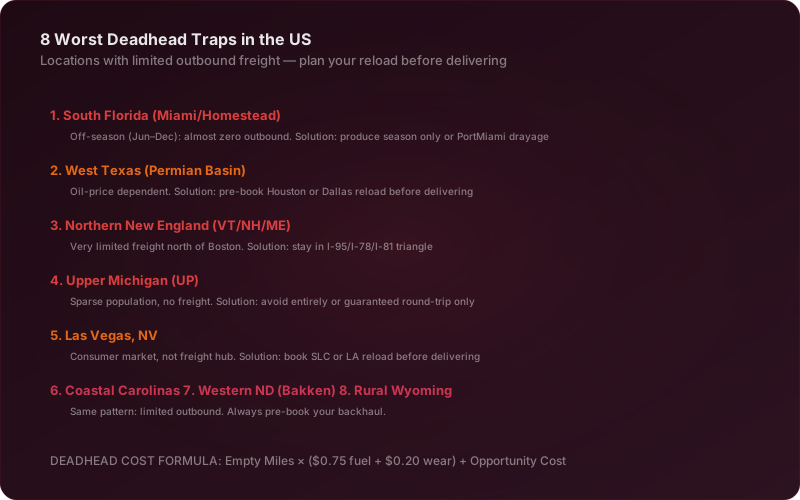
The 8 Worst Deadhead Traps in the US
These are the markets where carriers most often end up running empty. Some are seasonal traps that catch drivers off-guard. Others are structural — the geography and economy of the area simply do not produce enough outbound freight to match what comes in. Knowing these traps before you accept a load is the first step to avoiding them.
South Florida (Miami / Homestead)
The classic deadhead trap. Strong produce freight flows inbound from January through May, but the region becomes a freight desert the rest of the year. After delivering, the nearest reliable loads sit in Orlando (230 miles) or Jacksonville (350 miles). Thousands of carriers learn this lesson the hard way every summer, sitting in Miami truck stops refreshing load boards and watching rates crater as supply overwhelms demand.
Only run into South Florida during produce season from January through May, or with a confirmed outbound load already booked. Off-season, look for PortMiami container drayage or relay loads that only take you to Jacksonville. If no outbound exists, do not accept the inbound — no matter how good the rate looks.
West Texas (Permian Basin)
Oil field freight pays $5 to $6 per mile inbound to Midland and Odessa, which makes it look irresistible. The catch: almost zero outbound freight exists. The Permian Basin produces oil, not consumer goods. Your nearest loads sit 300 miles away in Dallas-Fort Worth or 330 miles away in Houston. That premium inbound rate evaporates when you deadhead 300 miles to find your next load.
Plan round-trip circuits before accepting the inbound. Book your outbound load from DFW or Houston first, then accept the Permian delivery. Alternatively, chain short-haul moves between well sites within the basin — some operators build profitable mini-circuits running pipe, sand, and equipment between locations. Never park in Midland waiting for something to appear on the board.
Northern New England (VT, NH, ME)
Low population density and minimal manufacturing mean freight barely exists north of the I-90 and I-95 corridor. After delivering to Burlington, Portland (ME), or anywhere in rural Vermont and New Hampshire, you face 100 to 200 empty miles just to reach areas where loads actually post. In winter, road conditions make those deadhead miles even more painful.
Only accept loads into northern New England when the rate covers your round-trip deadhead back to the I-90 or I-95 corridor. The best time to run these lanes is summer, when tourism and seasonal construction create some outbound freight. In winter, treat any delivery north of Concord, NH as a premium-only run and price accordingly.
Upper Michigan (Upper Peninsula)
The UP is beautiful but nearly freight-free. Mining operations and paper mills represent the only real industry, and they tend to use dedicated carriers. General freight is almost nonexistent. After delivering, you face 200 to 300 empty miles south to reach the Mackinac Bridge, and even Sault Ste. Marie and Marquette have almost nothing outbound.
Only run into the UP for premium-rate loads that justify the empty return. In summer, consider the Great Lakes ferry shortcuts between Ludington and Manitowoc or between Muskegon and Milwaukee to reposition into Wisconsin freight lanes rather than backtracking through Lower Michigan. Never accept a UP load at standard rates.
Las Vegas, NV
Las Vegas is a massive freight consumer and almost zero producer. Hotels, casinos, convention centers, and restaurants require constant inbound deliveries of food, beverages, linens, construction materials, and fixtures, but the city manufactures almost nothing to ship out. After delivering, your nearest reliable loads sit 270 miles away in Los Angeles or 430 miles away in Phoenix.
Price every inbound Vegas load to cover your deadhead back to LA or Phoenix. Some construction outbound exists — Las Vegas has been in a building boom for years — but it is inconsistent and competitive. Your best bet is building relationships with Las Vegas-area brokers who handle construction material outbound and convention freight. Never accept a Vegas inbound at standard rates.
Coastal Carolinas (Myrtle Beach / OBX)
Tourist destinations are freight black holes. Myrtle Beach, Outer Banks, Hilton Head, and Wilmington all consume inbound freight for hotels, restaurants, and retail but produce almost nothing outbound. Seasonal demand makes it worse — summer inbound surges coincide with the lowest outbound availability because these areas have no industrial base beyond tourism.
Charge a premium on every inbound delivery to coastal Carolina destinations. Plan summer runs strategically — the construction boom in these growing coastal towns does create some building material and equipment outbound loads. Your best repositioning move is heading inland to I-95 or I-85 corridor cities like Raleigh, Charlotte, or Columbia where freight density is much higher.
Western North Dakota (Bakken)
The Bakken oil formation pays premium rates inbound — pipe, sand, equipment, and supplies all flow into Williston, Watford City, and Dickinson at elevated rates. But outbound freight is nearly nonexistent outside of oil-specific hauling. The nearest general freight loads sit 350 miles east in Fargo or 540 miles south in Minneapolis.
Run the Bakken as part of a planned circuit: Minneapolis to Williston (inbound oil field freight) to Fargo (outbound general freight) to Minneapolis. Never park in Williston waiting for an outbound load to materialize. If you cannot pre-book a Fargo or Minneapolis backhaul, the Bakken inbound rate needs to cover your 350-mile deadhead to Fargo at minimum.
Rural Wyoming (off I-80)
Wyoming has the lowest population of any US state, and once you leave the I-80 corridor, freight effectively stops existing. Towns like Cody, Thermopolis, Sheridan, and Lander are surrounded by hundreds of miles of open range with no distribution centers, no warehouses, and no manufacturing. Even I-80 itself can be sparse between Cheyenne and Rock Springs.
Stay on the I-80 corridor whenever possible — it carries transcontinental freight between Omaha and Salt Lake City. Only deviate off I-80 for energy-sector loads (coal, wind turbine components, oil field equipment) that pay enough to cover the full round-trip deadhead back to the interstate. Casper is the only off-interstate city with semi-regular outbound, and even that is limited.
Region-by-Region Backhaul Strategy
The United States freight market breaks into six broad regions, each with its own rhythm, its own high-density corridors, and its own dead zones. Understanding the freight flow patterns in each region lets you plan routes that minimize empty miles and keep you in areas where loads are consistently available.
South Central
Use I-35 as your spine. Dallas-Fort Worth and Houston always have outbound freight available regardless of season — they are two of the largest freight markets in America. San Antonio and Austin add density to the Texas Triangle. Avoid dead-end runs into the Permian Basin without a pre-booked outbound, and be cautious with South Texas loads that leave you near the border with limited options. Laredo has strong cross-border freight but can be competitive.
Southeast
Follow produce north from January through May — this is the Southeast's strongest freight season. In summer and fall, hub your operations around Atlanta, which consistently ranks as one of the top five freight markets in the country. Loads are available out of Atlanta 365 days a year across all equipment types. Avoid Miami off-season entirely. Use the I-75 and I-85 corridor between Atlanta, Charlotte, and Knoxville as your repositioning backbone.
Northeast
Stay within the I-95, I-78, and I-81 triangle where warehouse and distribution center density keeps loads available year-round. The Newark to Allentown to Harrisburg corridor is one of the densest freight regions in America. Use Pittsburgh as your pivot point for Midwest repositioning when Northeast rates soften. Avoid running north of Hartford or Albany without premium rates that cover your deadhead back to the corridor.
Midwest
Chicago has outbound loads 365 days a year — it is the single most connected freight hub in the country. Use it as your repositioning hub whenever you get stuck in the region. Indianapolis, Columbus, and Memphis round out the major Midwest hubs. Avoid Upper Michigan entirely unless rates are exceptional, and be cautious with rural Iowa, Minnesota, and Wisconsin runs off the interstate system during the off-season when agricultural freight slows down.
West Coast
Los Angeles always has outbound freight because the Ports of LA and Long Beach pump imported goods into the national supply chain constantly. Stay on the I-5 corridor between LA, Sacramento, Portland, and Seattle — this is where West Coast freight density lives. Avoid Las Vegas unless the inbound rate covers your deadhead back to LA. Inland Empire (Riverside and San Bernardino) is increasingly a major outbound market as warehousing shifts east from LA proper.
Mountain / Plains
Denver and Salt Lake City are the only reliable repositioning hubs in this vast region. Everything else is situational. Avoid North Dakota oil country without a pre-planned circuit. Avoid rural Wyoming off I-80. Boise has some outbound from agricultural and tech sectors. Albuquerque sits on I-40 and I-25 but freight is inconsistent. When running this region, always know where your next load is coming from before you accept the current one — the distances between freight markets are enormous.
5 Deadhead Reduction Strategies That Actually Work
Knowing the traps is half the battle. The other half is building systems and habits that keep your deadhead percentage low consistently, not just when you happen to remember. These five strategies are what separate the carriers running 8% deadhead from the ones stuck at 20%.
Pre-Book Your Backhaul Before Accepting the Headhaul
This is the single most effective deadhead reduction tactic. Before you accept any load into a known trap area, secure your outbound load first. If no outbound exists, either decline the inbound or demand a rate that covers the empty return. Professional dispatchers do this automatically — they never route a carrier into Miami, Midland, or Williston without an exit plan already confirmed. Think in round trips, not one-way runs.
Build Relationships with Brokers in Trap Areas
Every deadhead trap still has some outbound freight — it is just scarce and competitive. The brokers who operate in these areas know about loads that never hit public boards. A broker in Midland who trusts you will call you directly when pipe needs to move to Houston. A broker in Miami who knows your schedule will flag that rare northbound dry van load before it posts. These relationships take time to build, but they are the difference between sitting empty and rolling loaded out of trap markets.
Use a Dispatcher Who Understands Regional Freight Patterns
A dispatcher who knows that Miami goes dead in June, that Bakken freight is one-directional, and that the Upper Peninsula has no outbound will never route you into those traps without a plan. Regional freight knowledge is the most valuable thing a dispatcher brings to deadhead reduction. They know which corridors produce reliable backhauls, which markets are seasonal, and which lanes are one-way money traps. This pattern knowledge takes years to develop and is worth every penny of a dispatch fee.
Run "Deadhead Math" Before Every Load
Before accepting any load, calculate the true net revenue including deadhead. The formula is simple: take the load revenue, subtract your cost to run the loaded miles, then subtract your cost to deadhead to the next load. Compare that net figure against alternatives. A $3,000 load that requires 200 miles of deadhead to the next pickup might net less than a $2,500 load with zero deadhead from your current position. Always run the math — gut feelings about "good rates" are how carriers end up in deadhead traps.
Position in Freight-Dense Corridors
The simplest deadhead reduction strategy is staying where freight lives. The I-35 corridor (Laredo to Dallas to Kansas City), I-75 (Miami to Atlanta to Detroit), I-95 (Miami to DC to Newark), I-80 (Chicago to Omaha to Salt Lake City), and I-10 (Jacksonville to Houston to LA) are the busiest freight lanes in America. When you stay on or near these corridors, your next load is always within a short deadhead. Every mile you stray from these trunk lines increases your deadhead risk exponentially.
Calculate Your Deadhead Cost
Every deadhead decision should be backed by math, not gut feelings. The formula for calculating deadhead cost is straightforward:
Deadhead Cost Formula
Deadhead Cost = Empty Miles × (Fuel Cost/Mile + Wear Cost/Mile) + Opportunity Cost
Your fuel cost per mile depends on your truck's MPG and current diesel prices — typically $0.60 to $0.80 per mile. Wear cost covers tires, oil, maintenance, and depreciation — usually another $0.15 to $0.25 per mile. Opportunity cost is harder to quantify but just as real: the revenue you could have earned if those miles had been loaded.
For a concrete example: 200 deadhead miles at $0.75 fuel cost plus $0.20 wear cost equals $190 in direct costs. If your average revenue per mile is $2.50, the opportunity cost of those 200 miles is $500 in potential revenue. Total true cost of that deadhead: $690.
We built a free tool to help you run these numbers instantly.
Related Tools & Resources
- Deadhead Miles Calculator — Calculate deadhead cost, fuel expenses, and revenue impact for any route
- Regional Freight Guides — In-depth freight patterns and top lanes for every US region
- Seasonal Freight Calendar — Know when produce, holiday, and construction freight peaks in each region
- Best & Worst States for Trucking — State-by-state breakdown of freight density, fuel costs, and regulations
Truck Dispatch Experts
Published March 1, 2026